Start a beginner language roleplay with manageable replies
A useful beginner roleplay gives you something small to accomplish: buy a ticket, choose a drink or ask where a room is. It should leave enough space for you to produce the words, rather than become a fluent conversation you can only watch.
Make success smaller than fluency
Choose a scene you already understand in your own language. Write the outcome before starting: ask the opening time, understand one answer, then thank the speaker. Avoid combining directions, reservations and complaints into the same first exercise. You need to know which action became easier when the session ends.
The Council of Europe describes language ability through particular communicative activities. Use that as a reason to choose an observable task; do not ask an assistant to certify your level from one exchange. A comfortable three-turn exchange is a useful practice result without being a proficiency assessment.
Give the assistant a speaking contract
Original practice prompt: “Be the attendant at a small museum. I am a beginner learning English. Use familiar words and one short sentence per turn. Ask only one question, then wait for me. My goal is to ask when you close and buy one ticket. If I say RESET, repeat your last sentence more simply. Correct one important mistake after the scene, not during every reply.”
Use a general assistant conversation with these instructions, rather than a translate-only session. Translation and roleplay have different jobs: an interpreter should preserve your words; a practice partner needs to invent the next conversational turn. If the assistant translates your request instead of playing the attendant, check the session role.
Run two passes with one changed detail
On the first pass, keep a small phrase card nearby: “What time do you close?”, “One ticket, please”, and “Could you repeat that?” Read from it if necessary. The card is a support, not evidence that you cannot learn. Ask for the written version of any reply you could not separate into words.
On the second pass, remove one line from the card and change just the closing time. Try to understand the difference rather than recite the first conversation. If you get lost twice, shorten the answer again. Adding ten new words because the first pass was difficult makes the next pass harder to interpret.
Inspect the breakdown instead of the score
After the roleplay, ask: “Quote one thing I said that worked. Show one correction that changes the meaning. Give me one new question using the same words.” Check that the quoted sentence actually appears in your conversation. A correction to a sentence you never said is not useful feedback.
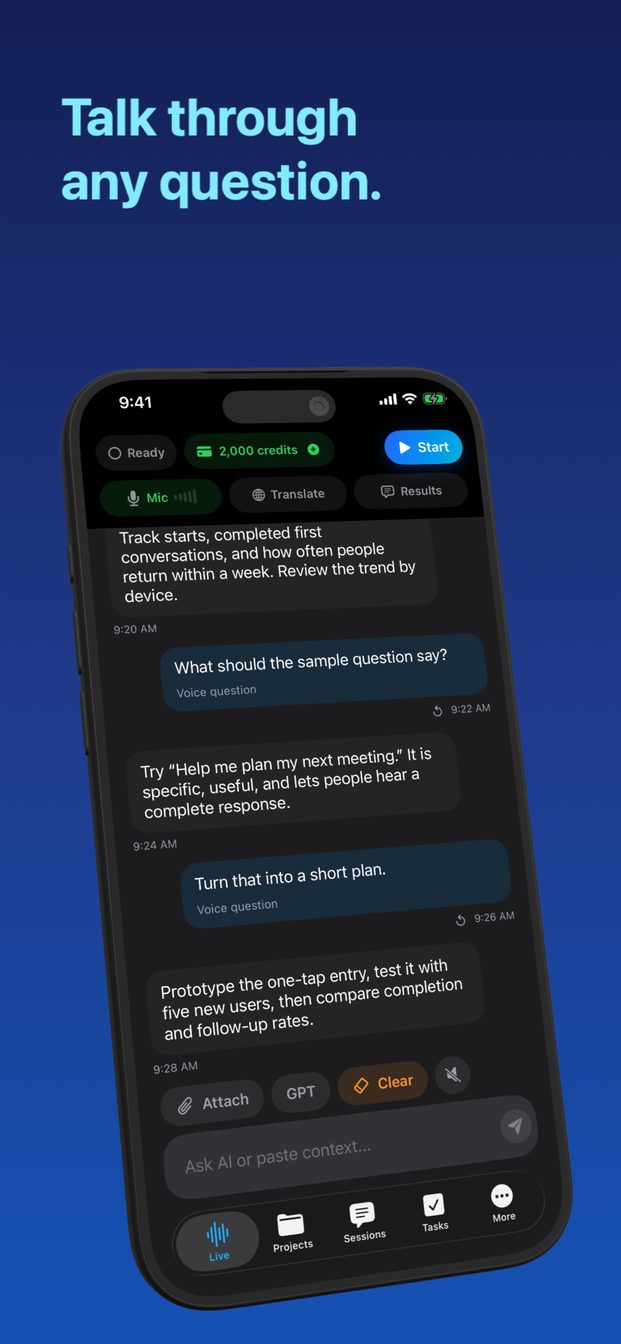
GPT Realtime Assistant can be used for this spoken practice. Treat generated examples as suggestions and check unfamiliar usage with a trusted dictionary or teacher. Its public iPhone and iPad sessions require an internet connection; this exercise is not a promise of an offline tutor. Save your own successful phrase and next goal in your practice notes.
FAQ
Should the assistant correct every sentence?
For this exercise, ask for one correction after the scene. Immediate corrections can be useful in a separate grammar drill, but they change the task from completing a conversation to editing every turn.
What if I cannot answer at all?
Use RESET, ask for two possible replies, choose one, and then try a new version without looking. Keep the next attempt short enough to finish.