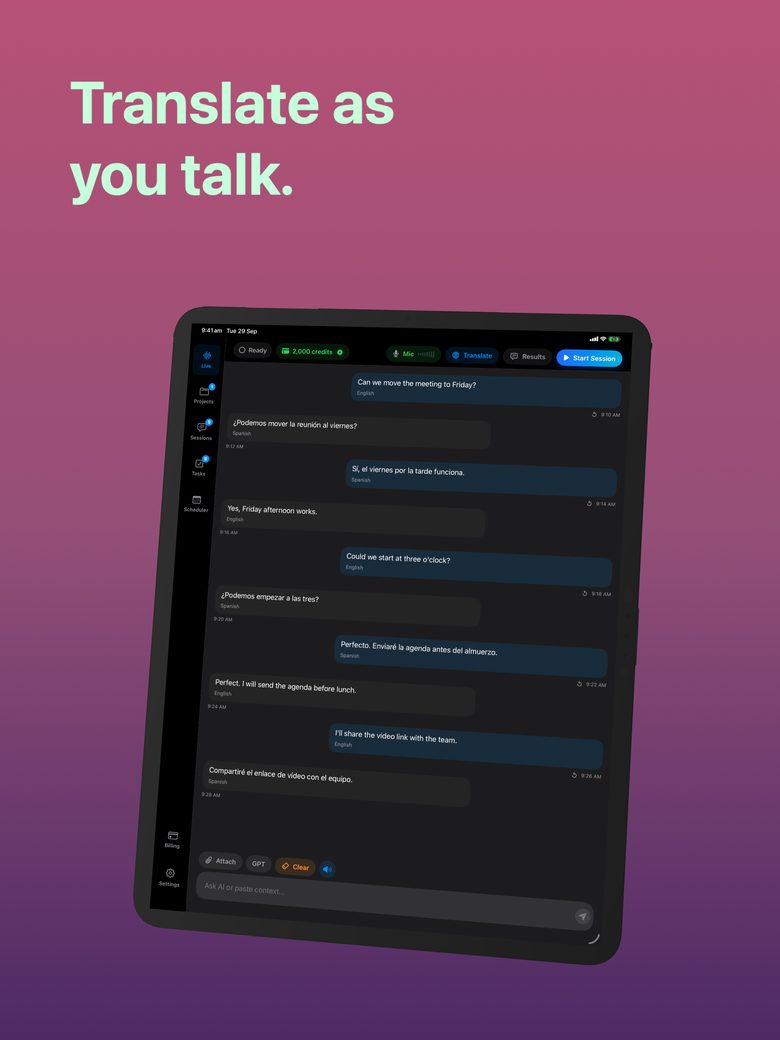
Rehearse an airport or hotel conversation before travel
Travel language practice is most useful when the normal exchange and the recovery both work. Rehearse asking for a room or gate, then rehearse what to do when the first answer is too fast or your request was misunderstood.
Choose one journey moment
Start with a particular scene: checking into a hotel after arriving late, asking where a bus leaves, or confirming whether breakfast is included. Write the facts you already know, such as the fictional booking name, number of nights and arrival day. Keep real passport details and payment information out of a practice conversation.
Decide which part you are rehearsing. Hotel check-in involves requesting and confirming information, while an airport disruption may require understanding alternatives. These are different exercises. The goal is a usable exchange, not an assistant improvising every possible travel problem at once.
Use a scenario with a controlled complication
Original prompt: “Play a hotel receptionist speaking English. I am a learner checking in for two nights under the fictional name Alex Vale. Ask one question at a time. Start with ordinary check-in. After three turns, tell me breakfast is not included. Let me ask the price. Do not invent a real booking or contact a hotel. After the scene, explain any ambiguous wording.”
Read your opening line aloud. When the assistant changes the condition, ask a follow-up instead of restarting: “Is that per person or per room?” This rehearses the information gap that actually matters. A grammatically elegant answer can still fail if it leaves the price unit unclear.
Practice three recovery moves
First ask for repetition: “Could you say the last part again?” Then narrow the question: “Was that seven or eleven?” Finally request a written answer: “Please write the departure time.” These are separate tools. Repeating the whole conversation may add noise when only one number was uncertain.
Use a fictional response such as “Breakfast is twelve per person, available from seven to ten.” Your check should recover the amount, unit and time window. Ask the assistant to repeat only the missing field. Later, change the numbers so that you must listen rather than remember the previous run.
Prepare a fallback before leaving
Keep the address, booking confirmation and a few checked phrases in a form you can open without a network connection. An online practice session does not make the app an offline interpreter. Test your actual fallback while disconnected before you travel, and keep a separate written copy of essential travel information.
In GPT Realtime Assistant, rehearsal belongs in an assistant session; translating what a real person says belongs in a translation session with the correct target language. Ask before using live audio around another person. For an important travel change, confirm with the transport provider or hotel rather than treating a generated response as a real policy.
FAQ
Should I practice a whole holiday in one session?
Practice one encounter until you can recover from a misunderstanding, then change the scene. This makes it easier to tell whether listening, vocabulary or the scenario caused the difficulty.
Can a roleplay confirm my actual reservation?
No. A fictional receptionist cannot check a booking. Use the hotel or airline confirmation channel for actual arrangements.