Rehearse the follow-up questions that expose vague answers
The first interview question gives you room to tell a prepared story. The follow-up tests whether you understand it. Rehearse the why, how and result questions that reveal missing detail rather than memorizing a longer opening.
Find the claim most likely to need evidence
Listen to your own answer for phrases such as improved the process, led the project or resolved a conflict. Each needs a concrete explanation. What did you do, which choice did you make, what alternative did you reject and how do you know what happened afterward?
Use a genuine example you are comfortable discussing. If the work is confidential, describe the structure without private names, figures or technical details. You should be able to explain your reasoning without exposing information a former employer or client expects you to protect.
Build a follow-up ladder
Take this invented claim: “I helped reduce confusion during handoffs.” A useful first question is “What was confusing?” The next is “What did you personally change?” Then ask “Why that change rather than another?” Finally, “What evidence shows it helped, and what remained unresolved?” Each step goes deeper without requiring an invented success metric.
An honest answer to the last question could be: “Two teams used the new checklist in the trial and reported fewer clarification messages, but we did not measure a long-term rate.” That is more defensible than a precise percentage remembered only after an assistant supplied it.
Prompt a realistic practice partner
Say: “I will give a behavioral answer. Ask one follow-up at a time about an unclear action, trade-off or outcome. Base it on what I actually said. Do not add facts, assign a score or tell me what an employer will certainly ask. Let me answer before giving feedback.” This keeps the exercise tied to your evidence.
If the model asks an unrelated technical question, redirect it: “Stay with the example I gave and test my decision about the checklist.” You are practicing depth, not collecting an endless list of possible interview topics.
Review where your evidence runs out
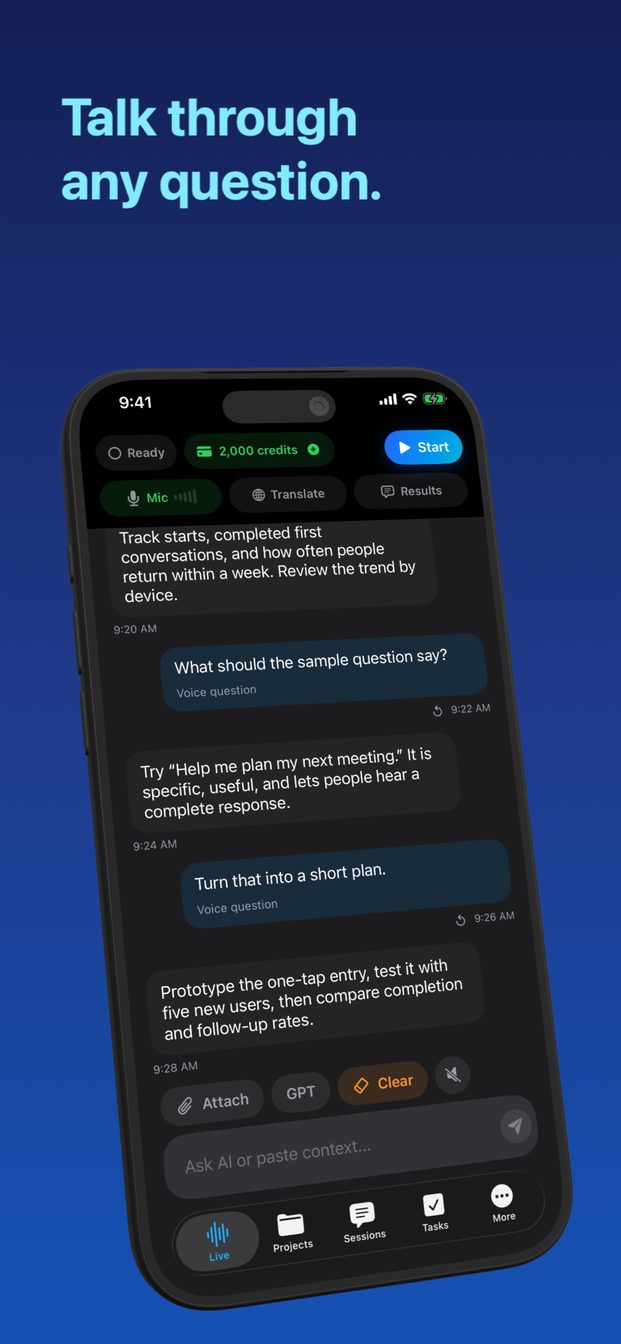
The National Careers Service explicitly recommends being ready for follow-up questions when using STAR. GPT Realtime Assistant's interview template can support this spoken rehearsal, but the model does not verify your history. Preparation should make you clearer about the facts you possess, including their limits.
- Give the initial answer once, without interruption.
- Underline vague claims in the transcript or your notes.
- Rehearse one why, one how and one outcome question.
- Distinguish your contribution from work done by colleagues.
- Mark a missing detail for verification rather than improvising it.
- Repeat with a different example to avoid learning only one story.
Learn to acknowledge an unknown naturally
Practice sentences such as “I do not have the exact number, but I can explain the change we observed” or “That decision belonged to the team lead; my responsibility was the trial.” These are not evasions when followed by useful evidence. They prevent a plausible answer from growing beyond your experience.
Use this exercise before the real interview. Do not use covert prompts or undisclosed live assistance to bypass an assessment. A successful practice session leaves you able to explain the work in your own words and handle a new question without depending on a memorized script.