Rehearse a STAR answer without sounding scripted
STAR helps you show what happened, what you needed to do, what you personally did and what followed. The useful part is the evidence in those four stages, not remembering the acronym perfectly while speaking.
Pick a story you can defend under follow-up
The National Careers Service describes STAR as Situation, Task, Action and Result. Choose one real episode that fits the skill being asked about. A small example with clear responsibility can be stronger than a grand team success where your own contribution is hard to explain.
Before rehearsing, write what you know and what you would have to guess. If you do not know a measured outcome, do not invent one. You can explain an observable result, the feedback you received or what you learned, provided you distinguish those from verified quantitative impact.
Give the action enough space
An invented example might begin: “Two teams used different handoff checklists, so requests repeatedly returned for missing information. I was asked to propose a common intake.” The action could be: “I compared recent returned requests, asked each team which fields mattered and drafted a small checklist for a trial.” The result might be: “The teams agreed to use the revised checklist for the next cycle; I do not have a long-term performance measurement.”
That answer has a visible personal action and a bounded result. It would become misleading if polished into “I transformed the process and cut delays by half.” Do not let an assistant supply impact merely because the ending sounds more impressive.
Rehearse with a skeptical but fair listener
Use: “Ask me a behavioral interview question about solving a process problem. After my answer, identify any missing STAR element and ask one follow-up about my personal action. Do not supply facts for me. Treat this as preparation, not a live interview.” Give your first answer aloud without reading the notes.
A good follow-up for the example is: “How did you decide which fields belonged on the common checklist?” That tests the reasoning behind the action. A generic compliment such as “great leadership” teaches you less than a question you need real evidence to answer.
Review the first attempt
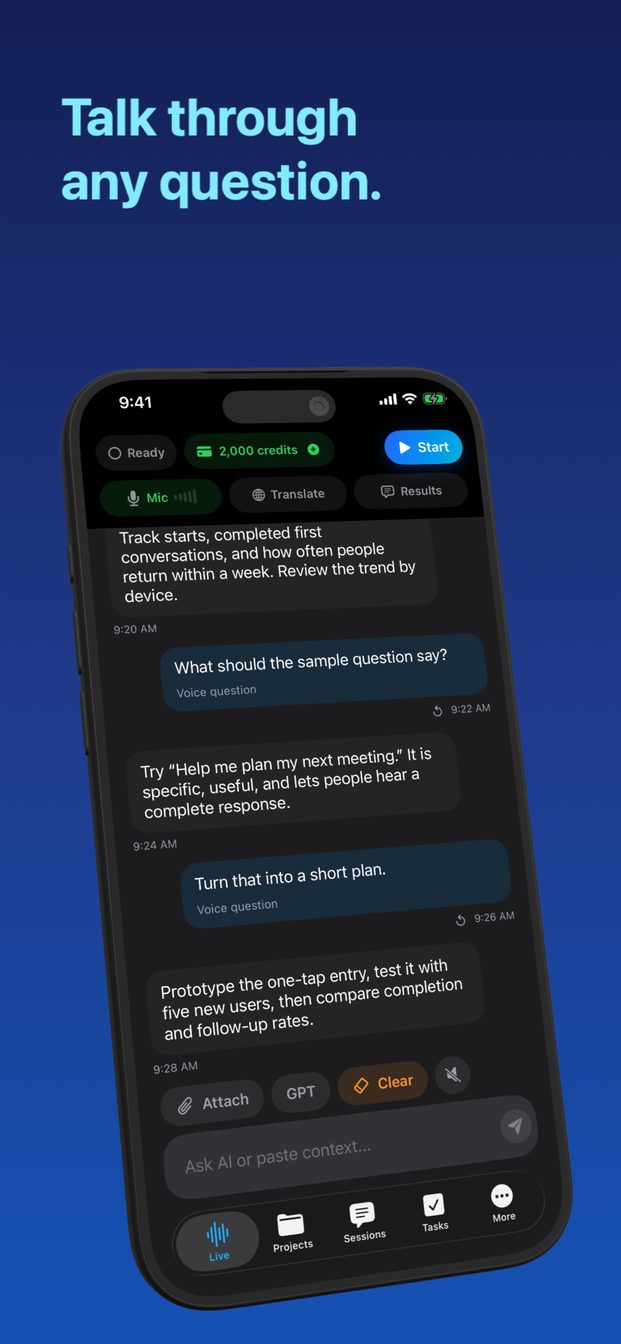
GPT Realtime Assistant offers an interview template and spoken interaction. It does not verify employment history or certify interview readiness. Its feedback is a practice aid that you should compare against your own records and the role's requirements.
- Limit the setup to the context needed to understand the problem.
- State your responsibility separately from the team's overall goal.
- Name the actions you took, including a meaningful choice.
- Explain the result with the evidence you actually have.
- Add one limitation or lesson where it changes the interpretation.
- Practice a shorter version without deleting the core action.
Avoid sounding like a memorized framework
Keep the story's facts stable while changing the wording between attempts. You need not announce Situation, Task, Action and Result out loud. Listen to the actual question: an answer about conflict may need a different emphasis from the same episode used to discuss planning.
Prepare more than one story, but do not reuse a single example mechanically for every skill. During the real interview, follow the employer's rules and answer from your own experience. The rehearsal succeeds when you can explain your reasoning naturally and acknowledge a result's limits without losing the thread.