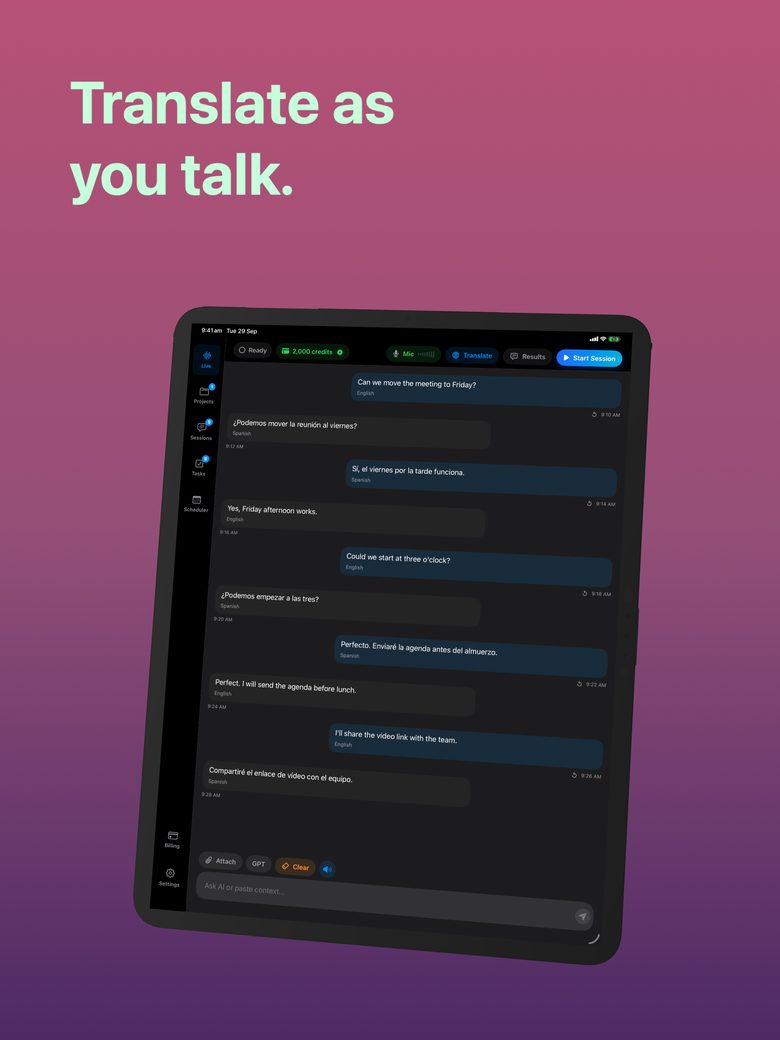
Review vocabulary from a practice conversation
A conversation can contain dozens of unfamiliar words, but only a few deserve your next review. Choose phrases you tried to use, misunderstood or expect to need again, then make yourself retrieve them in a different situation.
Collect the useful moment, not every word
After a practice session, identify three moments: a reply you could not understand, something you wanted to say, and a useful expression that appeared naturally. Keep the original sentence beside each phrase. A detached translation may hide the meaning or grammatical pattern you were actually using.
For example, “Could you put that aside?” can be useful in a shop, but the phrase needs context: you are asking someone to reserve an item briefly. Do not turn it into a universal translation for saving a digital file or setting a policy aside. Your example should carry the intended situation.
Ask for a small review card
Original prompt: “From this practice exchange, suggest three phrases worth reviewing. Quote the exact source sentence for each. Explain the meaning in this situation, not every dictionary meaning. Give one new example and one question that would make me use the phrase. If a phrase is not in the supplied exchange, label it as an additional suggestion.”
If you use GPT Realtime Assistant, provide the relevant excerpt or refer clearly to the session you are reviewing. This is a prompt-driven exercise; it does not promise automatic flashcards, spaced repetition or a vocabulary database. Save the reviewed cards yourself in the tool you prefer.
Check a worked card
A sample card might contain: phrase, “Would that be possible?”; context, asking to leave a bag before check-in; purpose, a polite request; new use, asking to move a meeting. Your own sentence should use the phrase for a similar purpose but with different facts. Merely repeating the supplied example tests memory of the example.
Check the proposed meaning against a reliable dictionary or a teacher when the expression is unfamiliar. Ask whether the phrase is neutral, casual or formal and whether it needs a particular preposition. If two suggested phrases have nearly identical meanings, keep the one you can actually imagine using rather than expanding the list for its own sake.
Test recall in a fresh exchange
Put the cards away and ask for a new roleplay that gives you a reason to use one phrase without naming it. If you cannot retrieve it, ask for a clue about the situation before revealing the exact words. Record whether you recalled it unaided, with a cue or only after seeing the answer.
Return to the same phrase in a later session, then retire it from frequent review once it becomes comfortable. This is a personal practice routine, not a guaranteed learning schedule or an official proficiency score. Useful progress means being able to choose the expression in context, including recognizing situations where it would sound unnatural.
FAQ
How many phrases should I save?
Start with three you expect to reuse. Expand only if you actually review and produce them in new contexts.
Should I translate each phrase word for word?
Keep the meaning and situation together. Word-for-word equivalents can miss idioms, politeness and the grammatical pattern around the phrase.