Choose a translation tone without changing the meaning
Changing tone should not change what you promise. A friendly translation of “We may finish on Friday” must not become a confident commitment to deliver on Friday.
Supply relationship and purpose
Tell the translator who is speaking to whom and why: a first message to a hotel, a familiar colleague asking for a favor, or a short update to a customer. These facts guide politeness more usefully than a vague request to “make it professional.” Avoid inventing personal attributes to justify a particular form of address.
Keep the intended meaning separate from the desired tone. Write the action, timing, certainty and any conditions that must survive. For a sample request, “Could we move our call to Thursday if that works for you?” contains a proposed change and room for refusal. Both should remain visible in the translation.
Request comparable alternatives
Original prompt: “Translate this message into English in two versions: neutral polite and friendly informal. Preserve the same request, deadline and uncertainty. Do not add apologies, promises or reasons that are absent from the source. After both versions, explain any difference in relationship or implied pressure. Message: We may finish the draft on Friday; I will confirm after the review.”
Compare the versions by meaning before choosing the one that sounds best. A formal opening is not a license to turn “may” into “will.” If the assistant adds “We guarantee,” reject that version regardless of how polished it looks. Ask it to show where each commitment came from.
Use a meaning ledger
For the sample, the ledger contains four facts: the deliverable is a draft, Friday is uncertain, a review comes first, and confirmation follows the review. Check each fact against both outputs. This makes the review possible even when the sentence structure changes substantially.
When the target language distinguishes forms of address, ask which relationship the chosen form implies. If you cannot judge it, ask a competent speaker who understands the context. General AI suggestions are not a substitute for knowing how a particular workplace, family or region handles politeness. Avoid assuming one “formal” form fits every situation.
Keep translation and rewriting labeled
A translator preserves the source. A rewrite may deliberately improve an awkward or insensitive source message. Both can be useful, but ask for separate outputs: “Translation of my original” and “Suggested rewrite.” Otherwise you may unknowingly send new content while believing it is only a translation.
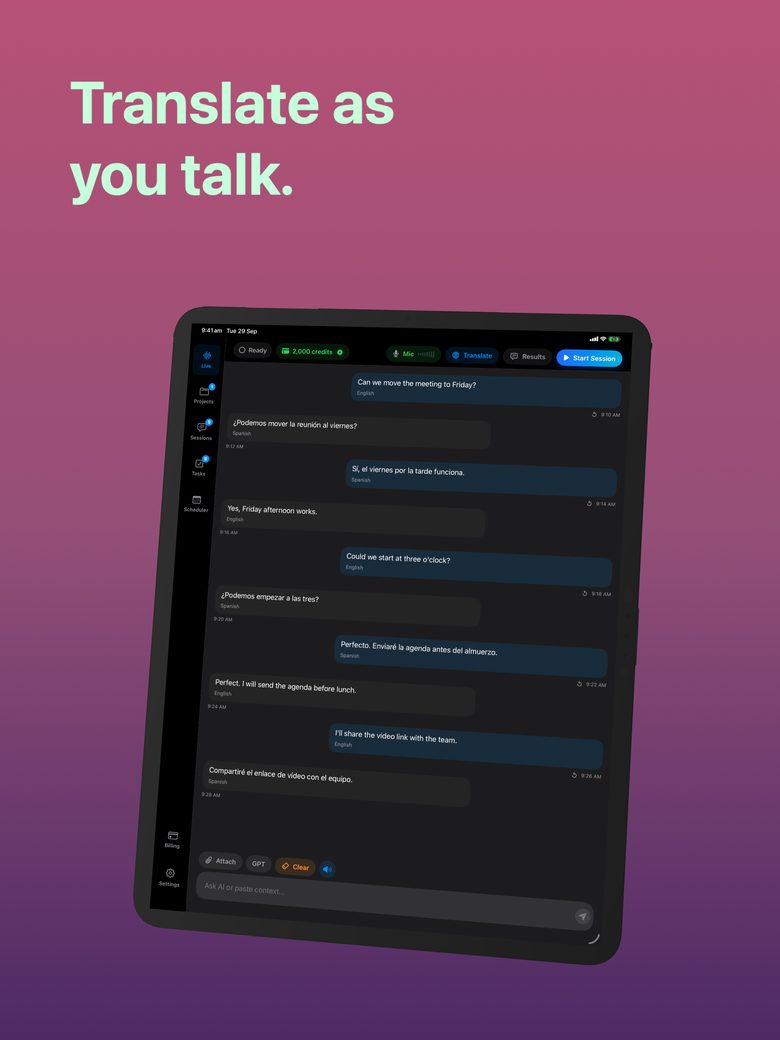
In GPT Realtime Assistant, use an assistant discussion to compare alternatives and a translation task when you need a faithful rendering. Inspect the final text before sending it yourself. This workflow does not imply automatic email sending or communication integrations, and an assistant cannot decide whether a commitment is appropriate on your behalf.
FAQ
Is a more formal translation always safer?
No. Excessive formality can sound distant or change the relationship. Choose wording for the audience while preserving the same meaning.
What should I check before sending?
Look for new promises, changed certainty, altered deadlines, missing conditions and forms of address that do not match the relationship.