Practice a clear answer to Tell me about yourself
A useful answer to Tell me about yourself gives the listener a route into your relevant experience. It is neither your entire biography nor a polished list of adjectives. Choose a short thread the interviewer can follow and question.
Choose the thread before the wording
Start with what you do now, connect it to one relevant piece of experience, and explain why the role is a sensible next step. This present, past and future structure is an editorial aid, not a rule every interviewer expects. Adapt it to the actual question and your genuine background.
Read the job description and select two responsibilities that connect to work you can discuss in detail. If you are changing careers, a project, volunteer role or course may provide relevant evidence. Do not invent a title or expand occasional exposure into expertise just to make the story more direct.
Build an example from real evidence
For an invented candidate moving from support into operations, a draft could be: “I currently coordinate customer support handoffs. I became interested in operations when I helped document a recurring escalation process and worked with two teams to make ownership clearer. I am now looking for a role where improving those cross-team processes is a larger part of the work.”
The answer gives an interviewer several honest follow-ups: what the process was, what the candidate personally did, and how ownership improved. Replace every example detail with your own evidence. A made-up percentage or responsibility can make the opening sound stronger while making the next question impossible to answer credibly.
Ask the assistant to rehearse, not impersonate you
Try: “Act as an interviewer in a practice session. Ask Tell me about yourself, then wait for my spoken answer. Identify one irrelevant detail, one unclear claim and one useful follow-up. Do not rewrite my experience or invent achievements.” Speak once before asking for an improved draft, so the first attempt reveals your real structure.
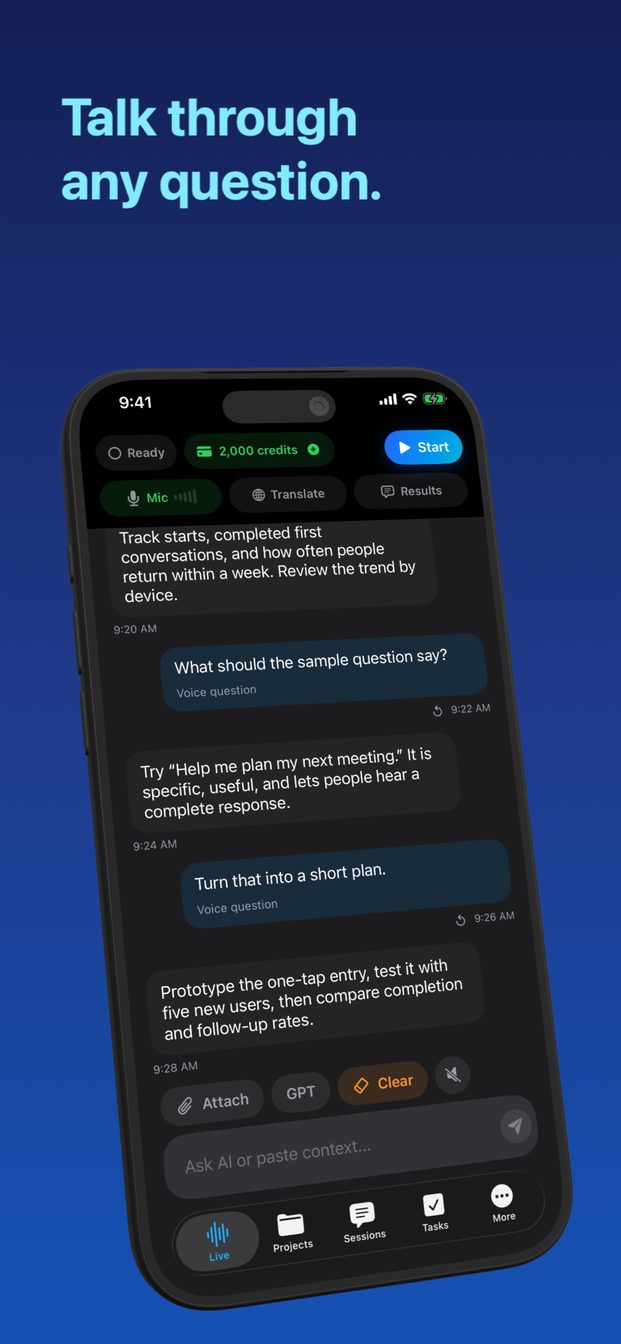
GPT Realtime Assistant supports interview templates and voice responses. Use it before the real interview to practice. Do not use a listening assistant covertly during an assessment or bypass the interviewer's rules. Preparation and undisclosed live assistance are different activities.
Improve one thing per repetition
Use a clock yourself if you want to control length; do not assume the assistant provides precise timing or an interview score. A concise opening should still leave room for natural follow-up rather than racing through a memorized paragraph.
- Write three factual anchors: current work, relevant example and next direction.
- Give the answer aloud without reading a full script.
- Check whether the first sentence explains your current role clearly.
- Remove a detail that does not help this particular audience.
- Replace one vague adjective with an observable example.
- Practice answering a follow-up about your actual contribution.
Test the answer with a different listener
Ask a friend to tell you which work they think you want to do next. If their interpretation is wrong, the link between your experience and the role needs attention. You may need a clearer transition, not more achievements.
The National Careers Service recommends real examples and conversational delivery for structured interview answers. Apply the same principle here: keep the factual anchors stable but vary the wording. The objective is to become easier to understand under pressure, not to produce a sentence so fixed that an interruption makes you lose your place.