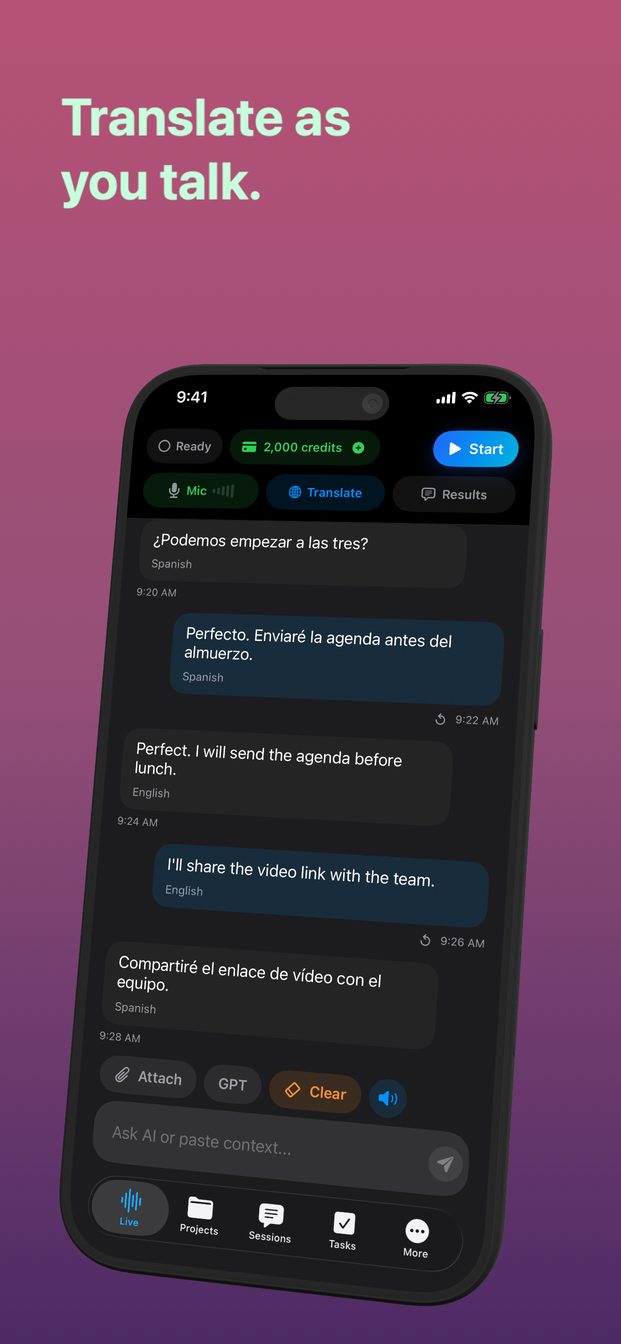
Use a translator or a language tutor for the right goal
A translator should carry your meaning into another language. A language tutor should help you learn, often by correcting mistakes and asking questions. If you use the wrong instruction, an AI may answer a sentence that you wanted translated or interrupt a conversation with lessons.
Decide whether the goal is communication or practice
In a real exchange, success may mean that the other person understands the time, location or request. During practice, success may mean noticing why your sentence was awkward and trying it again. The outputs and pace should differ because the goals differ.
Before starting, say which role you want. Do not assume that choosing a target language changes a general assistant into a strict translator. Check the active template or task in your installed version, and keep the source text visible when details matter.
Use a translator instruction with boundaries
Try: “Translate only what I say into the selected language. Preserve questions as questions. Do not answer them or add advice. If meaning is unclear, ask for clarification.” Then use a short neutral sentence such as a request for the next bus time.
The expected result is the translated request, not a guessed timetable. If the assistant answers with transport information, the task boundary failed. Restate the instruction with the sentence in quotation marks or use the product’s translation function. Verify recognition before judging the translated meaning.
Use a tutor instruction with a learning objective
For practice, say: “Roleplay a café conversation at beginner level. Ask one question at a time. After my reply, give one brief correction and let me try again.” This intentionally invites interaction and feedback rather than direct translation.
Keep the exercise narrow: ordering a drink, clarifying a price or explaining a preference. A tutor that corrects every small error may break fluency, so choose whether you want immediate feedback or a recap afterward. Generated feedback is guidance, not a certified language assessment.
Compare the same sentence in both workflows
Use a sentence with an ambiguity, such as a request involving “next Friday.” A communication workflow should preserve or clarify the intended date. A practice workflow can discuss how to phrase it unambiguously. The difference is the purpose of the response, not merely the output language.
If the source transcript is incorrect, both workflows start from the wrong material. Correct it or type the important words. For names, amounts and appointments, confirm in writing with the person involved rather than trusting a natural spoken voice as proof of accuracy.
Keep availability and stakes in view
GPT Realtime Assistant’s public mobile sessions require internet. General Apple Translate guidance about downloaded languages does not prove that every app mode or language pair works offline. Check the exact device, installed version and selected workflow before travel.
For consequential exchanges, use an appropriate human interpreter when needed and preserve an agreed written confirmation. For practice, accept that awkward turns can be useful learning material. The translator should not become a teacher without agreement, and the tutor should not be treated as a guaranteed interpreter.
FAQ
Why did AI answer my question instead of translating it?
The task may still be general assistance. Use a translation function or explicitly bound the quoted text and request translation only.
Can a spoken tutor certify pronunciation or fluency?
No. Generated feedback can help practice, but it is not an accredited assessment or proof that every sound was evaluated accurately.