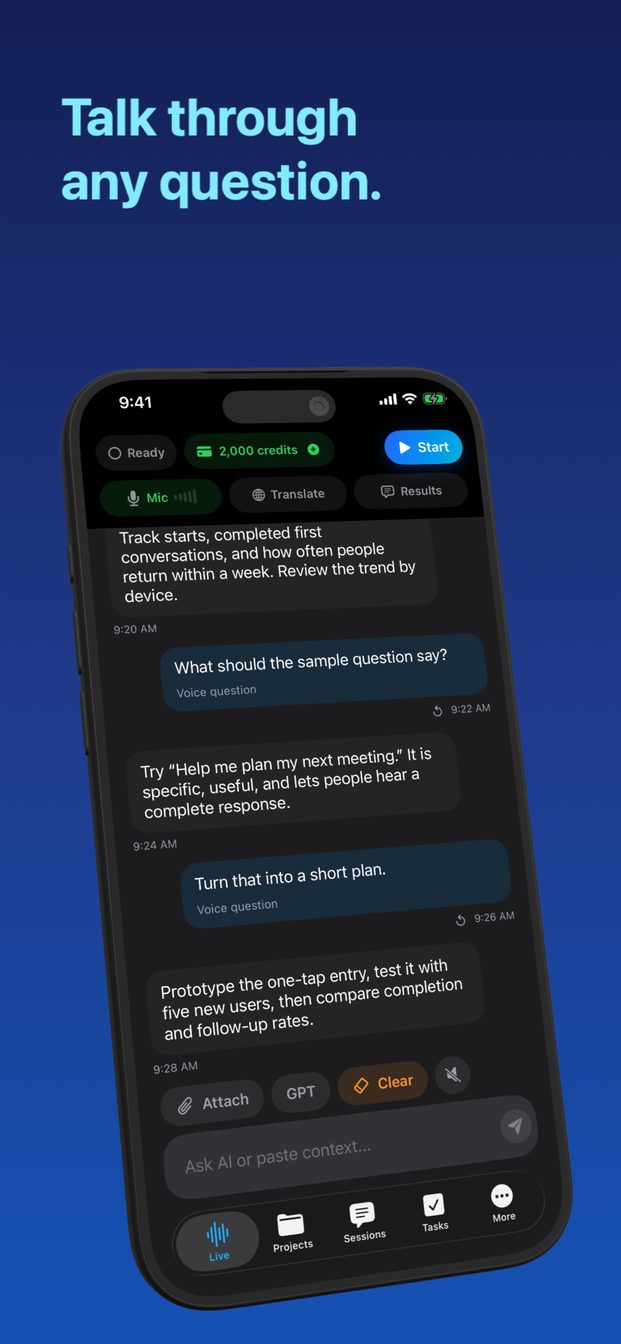
Practice a short elevator pitch with spoken feedback
An elevator pitch is a short opening that earns the next question. It does not need to explain every feature or prove that everyone needs your product. Start with one listener and one problem that matters to them.
Define who is listening and why
A potential customer, colleague and hiring manager need different openings. Before rehearsing, write what the listener already knows and what you want them to understand next. “Our product improves productivity” is broad enough to fit almost anything. “We help a support lead see which handoffs still need an owner” creates a concrete subject for discussion.
Choose an honest next step: a question, a demonstration or a follow-up conversation. Avoid asking the pitch to close a complex sale on its own. A short opening should make it easier for the listener to tell you whether the problem is relevant.
Assemble a small set of factual anchors
Use problem, approach and evidence. For an invented handoff tool, the problem could be requests getting stuck between teams. The approach could be a shared ownership checklist. The evidence might be a small internal trial, if that trial actually occurred. If you have no outcome data yet, state the test you are running instead of manufacturing a result.
An illustrative pitch is: “We are testing a simple way for support leads to spot handoffs without a current owner. It puts the ownership check beside the request, so teams can discuss the gap before it becomes a delay. We are looking for feedback from leads who handle cross-team requests.” This is an example of structure, not a claim about an existing product.
Rehearse through a voice session
Prompt: “Act as a busy support lead hearing my short pitch. Wait until I finish, then tell me what problem you think I solve and ask one practical question. Do not flatter me or invent product claims. If the audience is unclear, say so.” Speak the first attempt without reading a polished paragraph.
GPT Realtime Assistant can act as a conversational practice partner. It does not establish a real customer's interest, validate a business model or provide a reliable automated pitch score. Treat its response as one source of questions to test with people.
Improve the message with specific checks
If the model repeats your wording perfectly, that alone does not show understanding. Ask it to describe the problem using different words. Then compare its interpretation with what you intended to communicate.
- Use your own clock if you want a time limit.
- Remove terms the intended listener would need translated into ordinary language.
- Keep only the feature needed to explain the value.
- Replace unsupported superlatives with evidence or a clearly labeled hypothesis.
- Answer a question about who the product is not for.
- End with a relevant invitation rather than a generic sales command.
Take the pitch to a real listener
Ask someone in the relevant audience what they remember and what seems unclear. Do not lead them with “Was that compelling?” A better question is “What would you expect this to help you do?” Their answer can expose a promise you did not mean to make.
Keep the facts stable while varying the wording between rehearsals. The aim is a flexible explanation you can shorten, expand or interrupt naturally. A pitch that survives a genuine follow-up is more useful than a perfect script that only works when nobody asks a question.